
A Fault Detection Algorithm for LiDAR/IMU Integrated Localization Systems with Non-Gaussian Noises
Published in International Technical Meeting 2024, 2024
1) What problem is this paper solving?
Context: Detecting faulty measurements in EKF-based systems under non-Gaussian nominal error.
Core contribution: A fault detection method using GMM noise modeling and a transformed test statistic.
Achieved goal: Improved sensitivity to small and slowly increasing faults.
2) Why is this paper important?
What changed: Sensor noise in complex environments is rarely Gaussian.
Problem created: Gaussian-based detectors miss subtle faults or react too slowly.
Why current solutions fail: Mismatch between the assumed (Gaussian) and actual (GMM) noise distribution.
3) How does this paper solve it?
Contribution 1: Models LiDAR range noise as GMM and proves the EKF measurement residual is also GMM.
Contribution 2: Derived a transformation using the law of total covariance to standardize GMM residuals for chi-squared testing.
Key result: Demonstrated superiority in detecting small faults compared to Gaussian methods.
🎯 Takeaway: Accurate noise modeling is the key to sensitive fault detection.
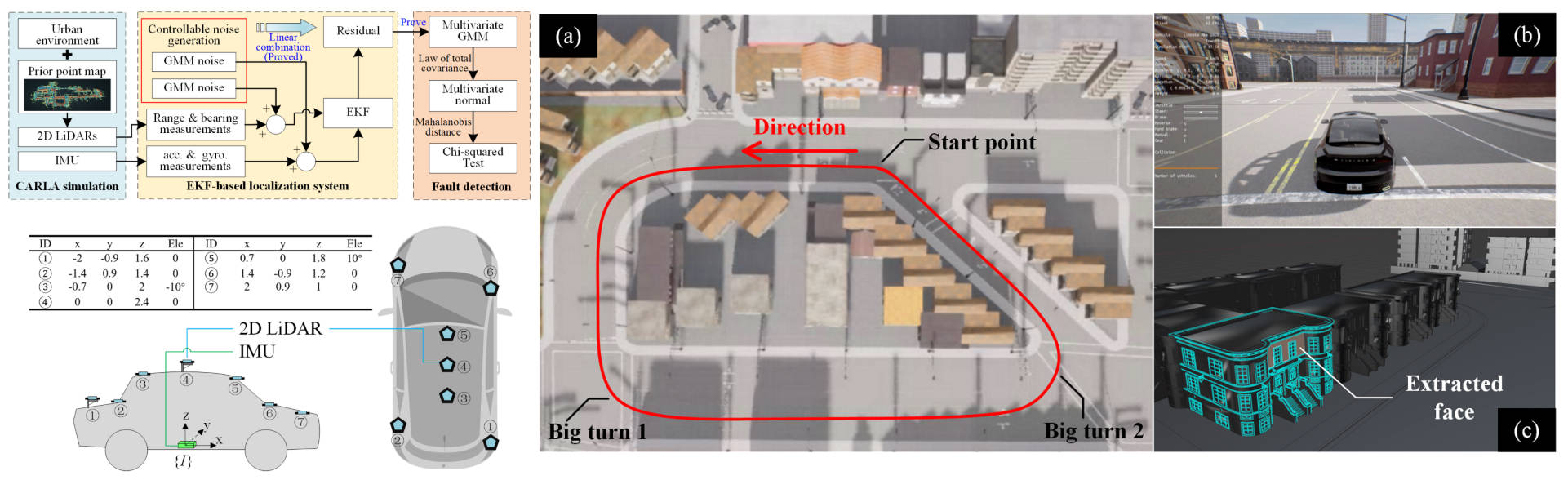 The architecture of the proposed method and the simulated environment where we apply the algorithm.
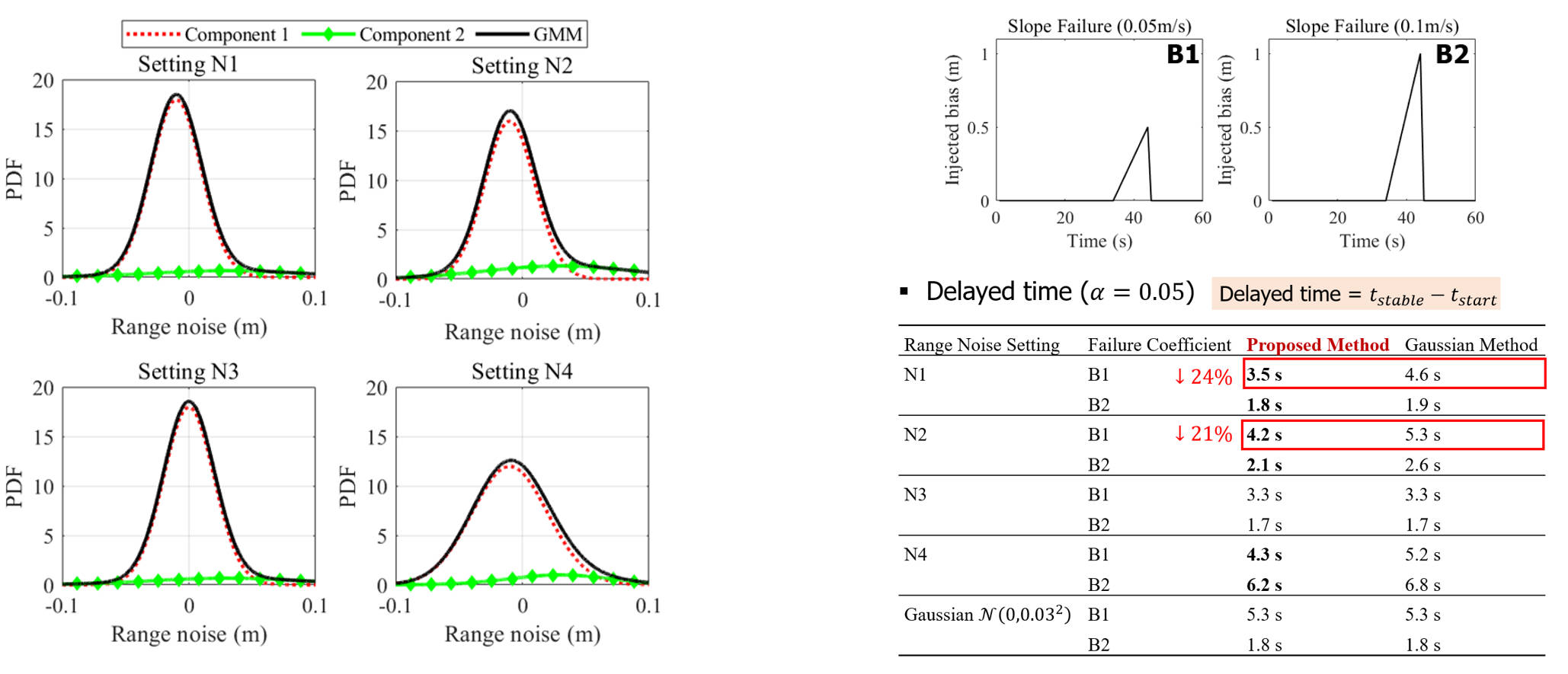 Four non-Gaussian noise settings, two types of slope failure settings, and comparison of the proposed method and the Gaussian method in terms of delayed time.
DOI: https://doi.org/10.33012/2024.19564
Download Paper Download Slides
Recommended citation:
Yan, P., Wen, W., Huang, F., & Hsu, L. T. (2024). "A Fault Detection Algorithm for LiDAR/IMU Integrated Localization Systems with Non-Gaussian Noises". In Proceedings of the 2024 International Technical Meeting of The Institute of Navigation (pp. 561-574).
BibTeX
@inproceedings{yan2024itm,
  author = {Yan, Penggao and Wen, Weisong and Huang, Fan and Hsu, Li-Ta},
  title = {A Fault Detection Algorithm for LiDAR/IMU Integrated Localization Systems with Non-Gaussian Noises},
  booktitle = {Proceedings of the 2024 International Technical Meeting of The Institute of Navigation},
  year = {2024},
  pages = {561--574},
  doi = {10.33012/2024.19564}
}