
Multiple Faults Isolation For Multi-Constellation GNSS Positioning through Incremental Expansion of Consistent Measurements
Published in IEEE Sensors Journal, 2024
1) What problem is this paper solving?
Context: Deletion-based greedy search algorithms suffer from “swamping” (wrongly excluding healthy measurements).
Core contribution: An incrementally expanding algorithm starting from a minimum fault-free basic set.
Achieved goal: Reduced swamping rate and improved post-isolation positioning accuracy.
2) Why is this paper important?
What changed: Multi-constellation GNSS increases the probability of multiple simultaneous faults.
Problem created: Aggressive exclusion by greedy search degrades satellite geometry and accuracy.
Why current solutions fail: They prioritize fault removal over preserving healthy measurements, leading to geometry loss.
3) How does this paper solve it?
Contribution 1: Constructs a minimum basic subset based on the smallest studentized residuals.
Contribution 2: Incrementally expands the set using jackknife residuals and no-fault hypothesis testing.
Key result: 50% reduction in swamping rate and 38% reduction in mean post-isolation positioning error.
🎯 Takeaway: Don’t just delete faults; incrementally build a healthy set to preserve geometry and accuracy.
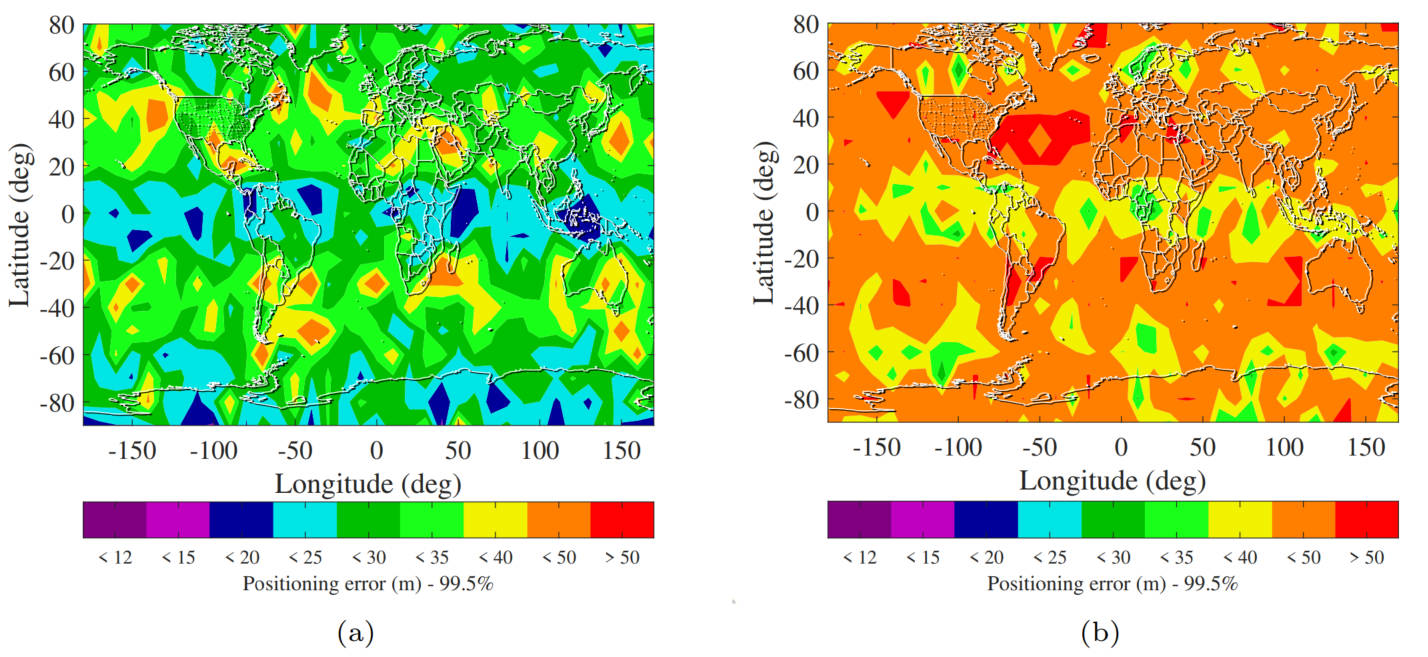
99.5% percentile of post-isolation positioning error over the course of the day by (a) the incrementally expanding algorithm and (b) the deletion-based greedy search algorithm in isolating multiple faults (six simultaneous faults, 20m, two constellation).
DOI: https://doi.org/10.1109/JSEN.2024.3524434
Recommended citation:
Yan, P., Hu, Y., Wen, W., & Hsu, L. T. (2025). "Multiple Faults Isolation For Multi-Constellation GNSS Positioning through Incremental Expansion of Consistent Measurements". IEEE Sensors Journal, 25(4), https://doi.org/10.1109/JSEN.2024.3524434
BibTeX
@article{yan2025mfdi,
  author = {Yan, Penggao and Hu, Yu and Wen, Weisong and Hsu, Li-Ta},
  title = {Multiple Faults Isolation For Multi-Constellation GNSS Positioning through Incremental Expansion of Consistent Measurements},
  journal = {IEEE Sensors Journal},
  year = {2025},
  volume = {25},
  number = {4},
  doi = {10.1109/JSEN.2024.3524434}
}